



Silkmark Tussar Vibrant Madhubani Blue & Purple Saree
Handcrafted at Indiehaat Bhagalpur Unit. Master Weaver: Wasif.

Celebrate tradition with our Handcrafted Silkmark Tussar Madhubani Saree. Adorned with intricate Madhubani paintings on Tussar silk fabric, each saree showcases the rich cultural heritage of Madhubani art, perfect for adding a touch of ethnicity to your ensemble.
Work: Madhubani Blockprint
Measurements: Length - 6.3-6.4 meter
*Blouse: Pallu Color
Blouse Piece: Yes
Fabric: Silkmark Certified Tussar Silk
Package Contains: 1 Saree with Blouse (attached)
Wash Care: Dry Clean Only. Keep them in separate bags in a dry place. Change folds and expose to non-moist air regularly. Dry in Shades.
Disclaimer:
Color hues may slightly vary from that which appears in the image due to different screens and displays
Minor irregularities is the uniqueness of handcrafted products and makes each piece exquisite
| Fabric / Material | Tussar Silk |
| Craft / Technique | Madhubani Block Print |
| Colour | Blue, Purple |
| Origin / Cluster | Bhagalpur |
Silk Mark Pure Tussar Silk refers to Tussar silk products that have been certified by the Silk Mark Organization of India. Tussar silk, also known as Kosa silk, is produced from the cocoons of wild silkworms and is prized for its rich texture and natural sheen. The Silk Mark certification ensures the authenticity and purity of Tussar silk products, guaranteeing their quality and origin. Tussar silk sarees and fabrics are highly valued for their luxurious feel and are often worn for special occasions and festivities.
Exchange: *Easy exchange is available within 3 days of receiving the product.
*No exchanges on home decor items.
*Unboxing video is required.
Return: *Only for damaged/wrong products.
*Unboxing video required.
Learn More
What kind of print does this saree have?
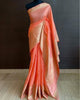
A geometric one. The blue body is printed in horizontal bands of diamond lattice in pink and cream, and the mauve-and-blue pallu carries a zigzag temple-style pattern. It looks structured and contemporary rather than pictorial, and the mauve gives the cool blue a soft accent.
Which blouse works with blue and mauve?
The attached pallu-coloured blouse keeps it coordinated. For contrast, a mustard or gold blouse warms the cool palette, while a mauve or plum blouse picks up the temple border. Silver jewellery suits these tones well.
Where would you wear this saree?
It is first a festive piece: the geometric blue and mauve print suits festivals and family celebrations. It also works for kitty parties, brunches and office parties. Its structured print makes it easy to wear to the office too.
What does tussar feel like?
Tussar, also called Kosa silk, comes from the cocoons of wild silkworms. It is prized for its rich texture and natural sheen, and this saree shows a soft slub across the surface. That textured ground gives the block-printed Madhubani motifs a handmade, earthy look.
Are small irregularities in the print normal?
Yes. Minor irregularities come with anything printed by hand: a block pressed a little lighter, a fine overlap at a join, a slight shift in tone. They show the saree was made by a person, and they make each piece a little different from the next.
Is there enough length for pleats and a full pallu?
Yes. At 6.3 to 6.4 metres, with the blouse piece attached, it gives you room for neat pleats at the front and a pallu that falls to a good length behind. That matters on a printed pallu, because you want the art to hang open rather than be tucked away.
What care does it need after a long event?
Let it air for a few hours in the shade, away from direct sun, so any moisture evaporates before you fold it. Then fold it into a breathable cotton bag and store it on its own. When it needs cleaning, send it to a dry cleaner; it should not be washed at home.




More sarees in blue
View all 14% off
 8% off
 12% off
 19% off
 19% off
 18% off
 21% off
 23% off
Bright & playful sarees for festive days
View all 21% off
 18% off
 21% off
 20% off
 12% off
 25% off
 21% off
 19% off
Handcrafted by Bhagalpur artisans
View all 18% off
 19% off
 25% off
 18% off
 19% off
 21% off
 21% off
 21% off
RECENTLY VIEWED PRODUCTS
Ada-e-Ramazan, All Products, Best Selling Products, Bhagalpur Sarees, Blue Sarees, Diwali Sale, Festive Sarees, Independence Day Sale, Kitty & Brunch Sarees, Madhubani, New Arrivals, Newest Products, Office & Workwear Sarees, Office Party Sarees, Playful Festive Sarees, Playful Kitty & Brunch Sarees, Playful Sarees, Printed & Painted Crafts, Pure Tussar Silk Saree, Purple Sarees, Puthandu Sale, Rang Rasiya, Republic Day Collection, Sarees, Savan, Silk Sarees, Silk Sarees Ad, Silkmark Certified Products, Silkmark Certified Sarees, Silkmark Certified Tussar Silk Madhubani Handblock Print Saree, Silkmark Tussar Silk Sarees, Ugadi - The New Year, VaraMahalakshmi Sale
