



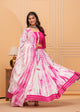
Festive Fusion Shibori White & Pink Lehanga Choli Set
Handcrafted at Indiehaat Blockprint Unit in Bagru. Master Artisan: Dinesh Kulwant.

Shibori Tie Dye cotton lehanga choli set, crafted with intricate designs and vibrant hues. This elegant ensemble offers a perfect balance of tradition and modernity, making it ideal for weddings, festivals, or special occasions.
Work: Shibori Tie Dye
Measurements: Top Size - 36-46 (S-XXXL), Length - 15-16 inch, Skirt Length - 16-17 inch, Flair - 5.5 Meter(28 Kali), Dupatta - 2.4-2.5 Meter
Fabric: Pure Cotton
Package Contains: 1 Lehanga, 1 Choli & 1 Dupatta
Wash Care: Dry Clean Preferred. Gentle Handwash with Mild detergents. Wash separately. Dry in Shades.
Disclaimer: Color hues may slightly vary from that which appears in the image due to different screens and displays
Minor irregularities is the uniqueness of handcrafted products and makes each piece exquisite.
| Fabric / Material | Cotton |
| Craft / Technique | Shibori Tie Dye |
| Colour | White, Pink |
| Origin / Cluster | Jaipur |
**Cotton** is a natural fiber harvested from the cotton plant, prized for its softness, breathability, and comfort. Strong yet lightweight, it absorbs moisture well and keeps the body cool, making it ideal for all climates. Widely used in clothing and home textiles, cotton is versatile, durable, and eco-friendly.
Exchange: *Easy exchange is available within 3 days of receiving the product.
*No exchanges on home decor items.
*Unboxing video is required.
Return: *Only for damaged/wrong products.
*Unboxing video required.
Learn More
What does the dye pattern look like?
Cloudy bursts of hot pink and yellow bloom across a white ground, made by tying and dyeing the cotton by hand. The colours blend softly where they meet, giving a sunny, playful look. The pattern is large in scale, so it reads well from across a room.
How is the dupatta different from the rest of the set?
The dupatta is a solid hot pink, which gives a strong block of colour against the cloudy skirt and choli. It ties the look together and keeps it from feeling too busy. The skirt's hem has a tie-dye band with thin gold lines for a finished edge.
How much volume does the lehanga have?
The skirt is cut with 28 kalis for a 5.5 metre flare. It falls with plenty of body and spreads the dye pattern wide when you turn. Being pure cotton, it feels light even with that much fabric at the waist.
How can I style it?
Keep jewellery light and fun: pink or yellow tassel earrings, a few glass bangles, or a delicate gold set. White or gold juttis work well. For a brunch, carry the dupatta loosely on one arm; for an evening, pin it on the shoulder.
How do I wash it?
Dry cleaning is preferred. If you hand wash, use a mild detergent, wash the set separately from other clothes and don't leave it soaking. Dry it in the shade so the pink and yellow stay bright for longer.
Why does each set look a little different?
Shibori is a hand resist-dye technique: the cotton is folded, tied or twisted before dyeing, and the dye spreads a little differently each time. So the shape and placement of the bursts vary on every set, and screens can also show colours slightly differently.




RECENTLY VIEWED PRODUCTS
All Products, Best Selling Products, Cotton Lehanga Set Handblock Printed, Diwali Sale, Festive Ready-to-Wear, Ganesha Chaturthi, Haldi Ready-to-Wear, Independence Day Sale, Jaipur Ready-to-Wear, Kitty & Brunch Ready-to-Wear, Lehanga Sets, Navratri, New Arrivals, Newest Products, Pink Ready-to-Wear, Playful Festive Ready-to-Wear, Playful Kitty & Brunch Ready-to-Wear, Playful Ready-to-Wear, Rang Rasiya, Republic Day Collection, Sangeet, Sangeet & Cocktail Ready-to-Wear, Sankranti, Savan, Shibori & Tie-Dye, Solace, Summer Vibe, Tie & Dye Crafts, Valentine Edit, Valentines Edit Pink, Valentines Edit White, White Ready-to-Wear
